Thermal efficiency and operational continuity for industrial plants
Lysor eliminates limescale, biofilm, and corrosion in cooling, heating, and process systems, improving performance and reducing operating costs without stopping production.
Why water is a key production factor
In industry, water is not just a service: it is an integral part of the process.
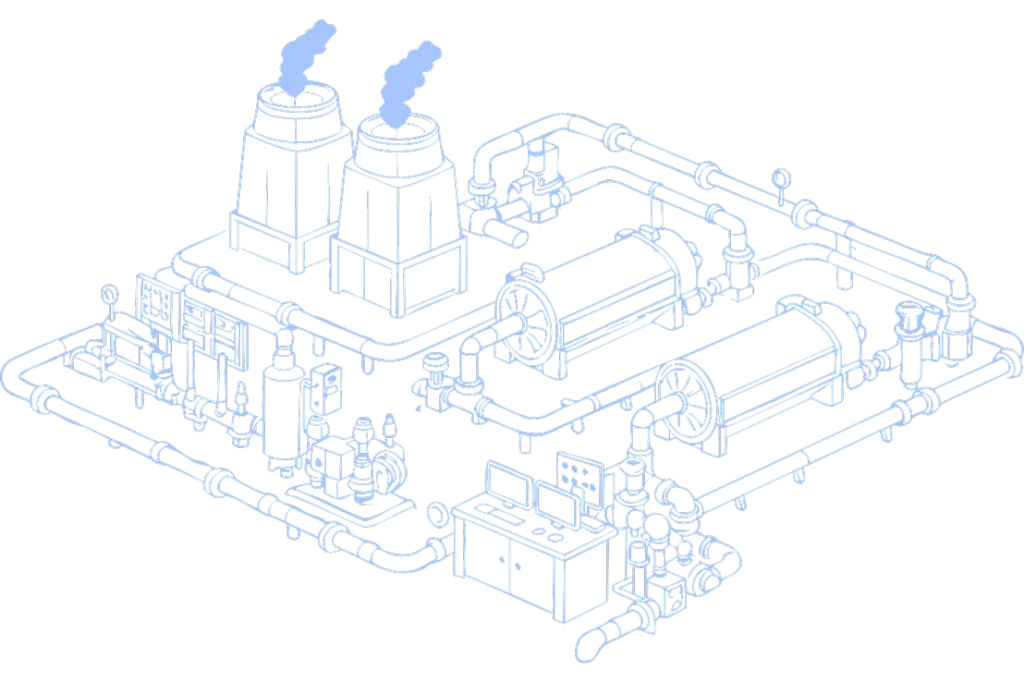
Exchangers, cooling towers, hydraulic networks, and thermal lines often operate at high temperatures and with large volumes of water, conditions that accelerate scaling, biofilm, and corrosion.
Lysor acts directly on the causes of these efficiency losses, keeping exchange surfaces clean, stabilizing flows, and improving the thermal behavior of systems—without stopping production and without using acids or aggressive chemicals.
More efficient heat exchangers and cooling towers, reduced consumption
Restored thermal efficiency
Limescale and biofilm compromise heat exchange and increase the energy requirements of industrial processes.
Lysor cleans exchange surfaces and restores exchangers and towers to their nominal values: in real cases, recoveries have reached 43% of the original efficiency in just a few days.
Cleaner circuits, lower pressure drops
The dissolution of scale improves circulation in cooling circuits and closed thermal circuits, reducing hydraulic resistance. This is critical in large industrial plants, where even small pressure drops affect process stability and pump consumption.
Optimized energy throughout the process
In industrial settings, 1 mm of limescale can reduce thermal performance by 15–20%.
By eliminating it, Lysor reduces the energy required for cooling, heating, and pumping, with measurable savings in operating costs and production cycles.
Deep decalcification
Limescale is one of the main causes of loss of efficiency in industrial settings: it insulates thermally, reduces flow rate, and forces higher energy consumption.
Lysor dissolves existing scale deposits on pipes, heat exchangers, and users, restoring full efficiency to the systems.
The descaling action works continuously, without stopping the production process and without risk to the lines.
Where Lysor is used
Typical applications of the treatment in industrial contexts.
01
Manufacturing and thermal industry
Industrial cooling systems (open and closed circuits)
Cooling towers
Plate or shell and tube heat exchangers
Boilers, evaporators, and high-temperature circuits
Production lines that use process water
Hydraulic systems subject to scaling or corrosion
02
Agri-food industry
Food storage and refrigeration systems
Heat exchangers and machine rooms
Internal hot and cold water networks subject to health and hygiene restrictions
Washing, cleaning, and sanitizing systems
Equipment and pipes where biofilm forms
03
Agricultural sector and irrigation
Irrigation systems with hard or ferruginous water
Networks with mineral occlusions or ferrous sediments
Main pipes and secondary distributors
Pumping and filtration systems
Wells and storage tanks used for irrigation
Concrete benefits for plants and production lines
More efficient heat exchangers and clean exchange surfaces
Improved thermal efficiency of processes
Reduction in energy consumption and operating costs
Less downtime and extraordinary maintenance
Prevention of future scaling and corrosion
Production continuity even during treatment
Academic validation
and real results
Lysor has been tested and validated by universities, independent laboratories, and healthcare facilities. Studies show significant reductions in biofilm, scale, and microbiological parameters
Proven effectiveness against limescale and biofilm
Over 58% reduction in scaling
Tests conducted on real systems have shown a significant reduction in limescale and the elimination of biofilm, resulting in a decreased bacterial load.
Reduction of microbiological parameters in healthcare settings
A study conducted on a hospital system showed a significant decrease in microbiological load and Legionella pneumophila, thanks to the blend’s action on biofilm and limescale.
Fill out the form to receive more technical details, commercial information, or request a personalized consultation.
Our team will get back to you as soon as possible.
Zero impact on water, maximum efficiency — ask us how.